
Hidden Harm
As my first post on this blog, I wanted to share not only a link to my registry to help those looking into creating a non-tox list of essentials but also share information I researched to create my registry. Let's get into it!
What is Non-Tox?
Products, lifestyle, more...
Non-Tox refers to products that are considered not poisonous or toxic. Many products on the market are created with chemicals or materials that can be harmful to you and/or your baby. A few categories I have researched are carcinogens, irritants, endocrine disruptors, and neurotoxins.
Chemicals to avoid to protect you & your baby:
1, 4-Dioxane is found in many soaps. It contains sulfates, which can cause irritation and allergic reactions as well as dryness of the exposed area (ex: skin or scalp)
Ammonium is commonly found in cleaning products and disinfectants. I personally make my own cleaning solutions ( see recipe post for some of my favorites), but you can also opt for cleaner formulas. Ammonium can cause respiratory issues like asthma and can be irritating to the skin and eyes.
Benzyl Acetate is commonly found in fabric softeners and dryer sheets. Not only does it cause build-up on your laundry but it also can be a skin irritant.
BPA (Bisphenol A) is a chemical compound used as a building block in plastic product such as containers, toys, bottles, aluminum canned foods, etc. When BPA plastic products are heated the harmful chemicals can leach into our food/bodies. BPA is a carcinogen and an endocrine disruptor.
Chlorine Bleach is used in many detergents (Laundry & Dishwasher), cleaners, toilet bowl cleaners, and disinfectants. It is harmful to the lungs, skin, and eyes. (Skin Irritant)
DEET is a neurotoxin found in insect repellent. Deet is a carcinogen and can cause seizures, low blood pressure, nervous system damage, and worse.
Flame Retardants are a huge toxin found in almost every material-based baby/children product. When I was creating my registry, this was the item I had to look out for the most, especially in strollers, car seats, mattresses, and clothes. In my opinion, a flame retardant is unnecessary in baby products. It may slow down the overall burning of a car seat, but if my car is on fire, that is the last thing I am thinking of. Even if you cannot find something that meets your needs without FR, you can purchase covers/shields for car seats and strollers that protect your babies' skin from the chemicals. These chemicals are linked to learning and developmental disabilities, thyroid hormone disruption, late puberty, reduced fertility, fetal malformations, and cancers. (Green Parent Guide: Chemicals to Avoid) Endocrine Disruptors, Skin Irritant, Carcinogen
Formaldehyde, a carcinogen, is found in some baby shampoos and soaps.
Glycol ethers are endocrine disruptors found in cleaning products.
MEA is an ammonia-like odor found in cleaners and detergents. While it is not listed as a carcinogen, it has been shown to cause developmental defects as well as tumors.
Oxybenzone is found in products like sunscreen. This can is a known irritant as well as an endocrine disruptor. Finding sunscreen alternatives while pregnant and on your babies is recommended.
Parabens are found in MANY personal hygiene and beauty products. It is categorized as an endocrine disruptor as well as a carcinogen. You may also find that it has an adverse effect on the purpose of the products (You buy shampoo to make your hair nice, but it has parabens that cause your hair to become dry, fall out, and turn crispy). The companies that have been selling you the parabens for years have all been promoting through commercials their "new" product that is paraben-free.
Perfluorooctanoic acid (PFOA)(Linked to Teflon) is something you may not find in your baby products, but you will certainly find it in your non-stick pots and pans. It has been linked to developmental delays and cancers.
Phthalates are another huge endocrine disruptor found in almost everything. They are found in many plastics, cosmetics, and hygiene products. Women can also be exposed to them during the prenatal stage, which can cause motor delays, behavioral issues, and developmental delays in the baby. Exposure to phthalates during your life, regardless of during pregnancy, is harmful to your hormones, fertility, and future children.
Polyurethane is a synthetic plastic found in mattresses, changing pads, and insulation like pillows. It helps make products resistant to chemicals and water, which is why it is used in many baby products. However, it is also an endocrine disruptor, irritant, can cause respiratory issues and pollutes the air.
Polyvinyl Chloride (PVC) -The core building block of PVC is carcinogenic. In order to make it more bendy, it contains more additives such as phthalates, which are known endocrine disruptors – substances that disrupt the normal hormone function in your body. And when it burns, it can spew noxious dioxins. You may find this in children's toys, wallpaper, shower curtains, and more.
Sodium laureth sulfate is found in some personal care products and may be contaminated with 1,4-dioxane, which is linked to cancer. (Green Parent Guide: Chemicals to Avoid)
Synthetic Fragrances use chemicals to mask scents. They are commonly found in detergents, perfumes, cleaning products, soaps, wipes, diapers, pads, etc. They are directly linked to phthalates (a known endocrine disruptor), carcinogens, and irritants. Most packages will just list it as "fragrance" or even "natural fragrance". Unless you can determine that it is an essential oil or something that is not harmful, it is best to stay away. Even essential oils can cause irritation to the skin, so products like wipes, soaps, and diapers should always be unscented.
Tributyl-tin is used a an antifungal agent in diapers. It is highly toxic and known as a hormone disruptor. Its original purpose was in marine paint to help prevent the fouling of boat hulls.
Triclosan is found in personal care products, household cleaners, and even some fabrics and plastics, where it acts as an antibacterial agent and/or preservative. Triclosan has been determined to be an endocrine disruptor, be linked to increased allergies, and a possible risk of cancer.
Volatile Organic Compounds (VOC) are chemicals that readily evaporate at room temperature, often releasing into the air as gases. Exposure may cause irritation, throat issues, and respiratory issues.
These are some of the big harmful toxins to look out for in products for yourself, your family, and your baby.
So why should you care about endocrine disruptors? What even are they?
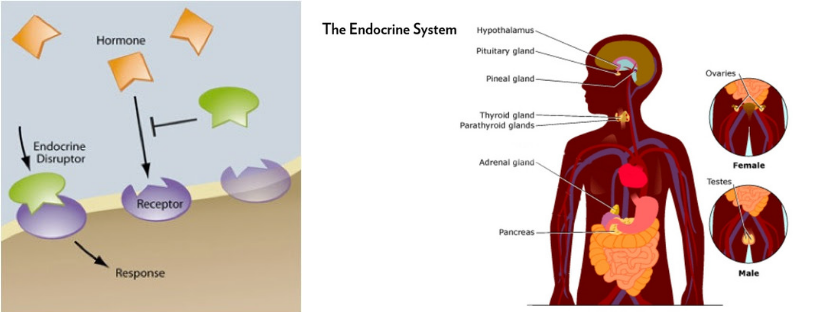
Endocrine disruptors are chemical compounds that interfere with normal functioning of the endocrine system, which regulates the bodies release of hormones into the blood stream. These hormones act as chemical messengers, coordinating various processes like metabolism, growth, development, mood, and reproduction. So as you can see, messing with the regulation of these hormones can cause serious developmental, behavioral, and fertility issues.
On a personal level, women who are exposed to these chemicals have been found to have reproductive deterioration and an increased diagnosis of reproductive disorders such as endometriosis, PCOS, infertility, menstrual irregularity, and more.
When exposed to these chemicals in the womb, a child can be at risk for adverse health impacts such as carcinogenic and mutagenic responses, neurophysiological effects, learning disorders, behavioral problems, increased aggressiveness, and fine and gross motor coordination.
I was recently listening to a Birthing Instincts podcast where Dr. Ben Lynch made a bold statement about women needing to not be selfish for 9 months while they carry their child; they can do anything for that short amount of time to protect their child from potential harm. I couldn't agree more. I am far from perfect, but I try very hard to limit my exposure to things that can cause harm or risks to the development and well-being of my future child.
Resources:
Author links open overlay panelSaqib Hassan a b, a, b, c, d, e, f, g, h, AbstractAn Endocrine Disrupting Chemical (EDC) is any compound that disrupts the function of the endocrine system in humans and is ubiquitous in the environment either as a result of natural events or through anthropogenic activities. Bisphenol A, Al-Amoudi, W. M., Atkinson, C., Axmon, A., Barton, M., Bath, S. C., Bouchard, P., Charlier, C. J., Chiaffarino, F., Cummings, A. M., … Enoch, R. R. (2023, October 12). Endocrine disruptors: Unravelling the link between Chemical Exposure and women’s Reproductive Health. Environmental Research. https://www.sciencedirect.com/science/article/abs/pii/S0013935123021898
Avoiding endocrine disruptors in toiletries, cosmetics and menstrual products. CHEM Trust. (n.d.-a). https://chemtrust.org/cosmetics/
Avoiding harmful chemicals in baby products: Advice for parents. CHEM Trust. (n.d.). https://chemtrust.org/advice-for-parents/
Branded, P. (2023, May 23). 29 potentially harmful chemicals in baby products. https://puracy.com/blogs/baby-care/baby-product-ingredients-to-avoid?srsltid=AfmBOorBC6HNAsN7K-4hNdIGd1CbttHdlcgJNYa4sbWAXSKfPw8axrqB
Non-toxic baby gear reviews and recommendations. Gentle Nursery. (n.d.). https://www.gentlenursery.com/category/baby-gear/
PVC has lost its shine – what is PVC and why we need to ban it. ClientEarth. (n.d.). https://www.clientearth.org/latest/news/what-is-pvc-and-why-we-need-to-ban-it/
Toxic chemicals commonly found in baby products. Women’s Voices for the Earth. (2020, January 24). https://womensvoices.org/avoid-toxic-chemicals/pregnancy/non-toxic-baby-tips/toxic-chemicals-in-baby-products/#:~:text=Bisphenol%20A%20(BPA)%20is%20found,early%20puberty%2C%20and%20developmental%20disorders.