
Cervical Checks & Fetal Monitoring
What is the deal with cervical checks? If you are like me you never really thought about this before. Before this year if a doctor told me to told something or suggested I do something, I would just think they knew best and agree. Cervical checks and fetal monitoring are one of those things that are more to make the doctor comfortable than you, but let's dive into this a little deeper.
Cervical Checks
Pain & Discomfort:
Some women find cervical checks physically or emotionally uncomfortable or even painful. Others don't mind them at all. Some say they felt fine until they received a cervical check, and then they started to have extreme cramping and harsh contractions, even potential bleeding.
Infection:
A study of more than 20,000 women laboring at term found that the number of cervical exams was associated with an increased rate of chorioamnionitis (an infection of the placenta and amniotic fluid). Women with more than seven cervical exams were over twice as likely to develop an infection. The study, published in the American Journal of Obstetrics & Gynecology, concluded that unnecessary cervical exams should be avoided during labor.
It’s possible for a provider to accidentally break the bag of waters during a cervical exam (one study showed that people who had weekly cervical exams before labor had a three times higher risk of their water breaking early compared with people who did not have cervical exams before labor)
 Megan Malone-Franklin
Fetal Monitoring
 Rebecca Dekker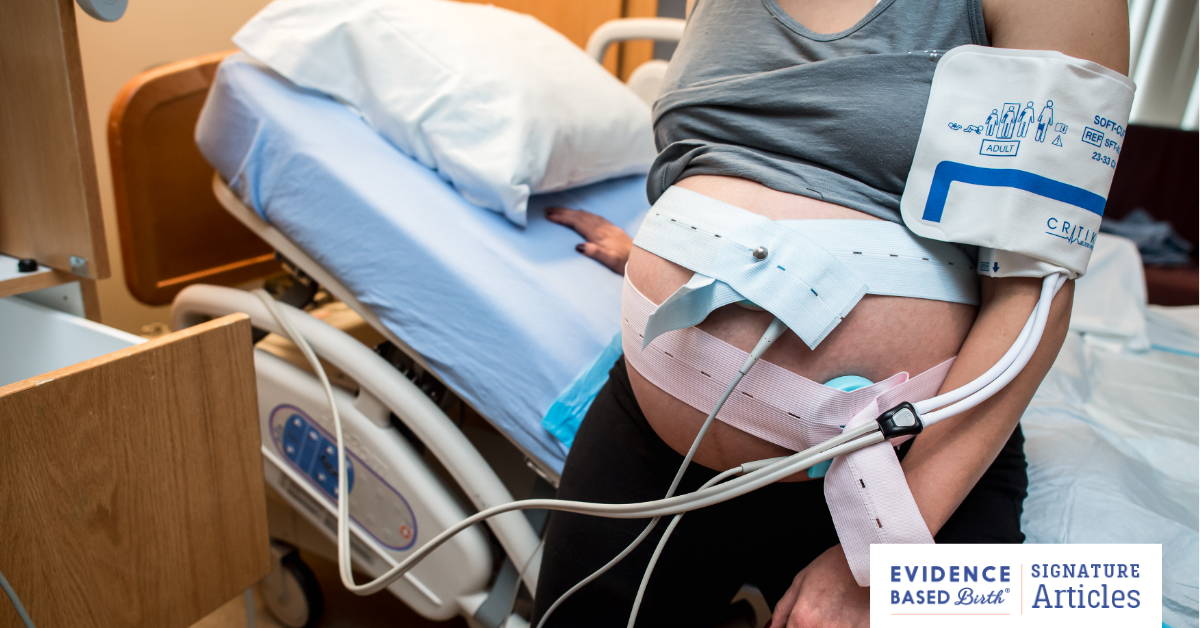
The article linked above explains everything based on evidence of testing.
Different Types of fetal monitoring include EFM, CEFM, MEFM, IFM, and HOL.
Electronic Fetal Monitoring:
EFM, also called cardiotocography (CTG), is when the baby’s heart rate is monitored with an ultrasound machine while the mother’s contractions are monitored with a pressure sensor.
Continuous Electronic Fetal Monitoring:
CEFM is the continuous use of fetal monitoring during labor. Electronic fetal monitoring usually requires that a mother wear two monitoring belts around her abdomen during labor, which restricts movement and may even require bed rest. This can also mean you lose the ability to use hydrotherapy as a pain management or labor strategy. In the article above, it states that in the test, the group that was being continuously monitored was 63% more likely to have a cesarean section and had received nurse feedback to limit their movement during labor.
Mobile Electronic Fetal Monitoring:
Some hospitals have wireless, waterproof electronic fetal monitors. Unlike traditional fetal monitors, some wireless monitors (like the Novii) are water resistant (can be used in the shower) or while the birthing person is laboring in upright, active positions away from a hospital bed. This could be the best of both worlds for you to be mobile and the doctor, but the fact that they can constantly monitor you still can cause a fear-mongering strategy, which can lead to medical interventions such as a c-section.
Intermittent Fetal Monitoring:
Intermittent means using something at regular time intervals, and not using it continuously. Nurses or doctors will monitor for a certain number of minutes per hour while you are in labor. It could be the last 15 minutes of every hour before, during, and after a contraction or two to check if the baby is doing well. This is typically done using a Doppler, which does not get strapped to you. Many women find this more appealing due to the nature of the freedom it presents. It also allows you to deliver in any position you choose, since they can just pop the Doppler on if needed.
Hands On Listening:
Another fetal monitoring option is intermittent auscultation, which is known as hands-on listening. With hands-on listening, the care provider listens to the fetal heart rate for short periods at regular intervals. They document the fetal heart rate, rhythm (regular or irregular), any fetal heart rate accelerations, and the depth, timing, and duration of any decelerations (Smith et al. 2016). While listening, the care provider also feels the mother’s contractions by placing a hand on the abdomen and documents the frequency, duration, and intensity of the contractions. This is the primary method of doing fetal monitoring at home births.
In conclusion, conducting your own research on fetal monitoring and cervical checks will provide an opportunity to stay ahead of the game when you get to the hospital for birth. This can also be a beneficial statement to make on your labor preference document.
Examples for Labor Preference Doc or Birth Plan:
I would prefer that my provider and nurses use intermittent fetal monitoring so that I may be mobile. If there is a situation that arises where we need to be monitored more frequently, please inform me, and I will most likely agree.
I would prefer that you limit the number of cervical checks and always ask me for consent before performing one. If there is an issue where the staff feels we need to check more than I would like, please inform me of the reasoning and ask for consent before performing the check.